You have heard about the FIRE movement. You know the 4% rule. Now you want to know: what is my number?
This post is not a re‑explanation of the 4% rule. (We covered the basics in our detailed guide to the FIRE movement.) Instead, this is a practical workbook to calculate your own FIRE number – with a free worksheet template, real examples, and mistakes to avoid.
By the end, you will have a clear, realistic target number and a simple way to track progress over time.
What You Will Learn
- A 4‑step worksheet to calculate your personal FIRE number
- How compound interest powers the 4% rule
- How to adjust for CPF (Singapore) and EPF (Malaysia)
- Common calculation errors that can delay your retirement by years
- Real examples: Sarah (SG) and Ahmad (MY)
Step 1: Calculate Your Annual Expenses (The Real Number)
Most people underestimate their spending by 20-30%. Do not guess. Track.
What to Include
| Category | Examples |
|---|---|
| Housing | Rent/mortgage, maintenance, utilities (electricity, water, internet) |
| Transport | Car loan/petrol/insurance, public transit, taxis, ride‑share |
| Food | Groceries, dining out, coffee shops, delivery apps |
| Insurance | Health, life, home, car insurance premiums |
| Healthcare | Doctor visits, medications, supplements, dental, vision |
| Personal | Clothing, haircuts, gym memberships, subscriptions (Phone bill, Netflix, Spotify) |
| Family | Childcare, school fees, allowance for parents, helper |
| Debt payments | Minimum payments on credit cards, student loans, personal loans |
| Discretionary | Travel, hobbies, gifts, entertainment |
| Irregular | Annual car maintenance, property tax, vacations (divide by 12) |
Worksheet (Copy and use)
| Expense Category | Your Monthly $ | Your Yearly $ |
|---|---|---|
| Housing | _____ | _____ × 12 |
| Transport | _____ | _____ × 12 |
| Food | _____ | _____ × 12 |
| Insurance | _____ | _____ × 12 |
| Healthcare | _____ | _____ × 12 |
| Personal | _____ | _____ × 12 |
| Family | _____ | _____ × 12 |
| Debt payments | _____ | _____ × 12 |
| Discretionary | _____ | _____ × 12 |
| Irregular (averaged) | _____ | _____ × 12 |
| Total | _____ | _____ |
Pro tip: Use three months of bank statements. Do not guess. The number will be higher than you think – and that is okay. Honesty is the first step.
Step 2: Adjust for Retirement (Your Expenses Will Change)
Some expenses go down. Some go up. Be realistic.
| Expense Category | Change in Early Retirement | Multiplier (vs. current) |
|---|---|---|
| Work‑related (commuting, work clothes, daily lunches) | Decrease | ×0.5 or ×0 |
| Housing (if mortgage is paid off) | Decrease | ×0.3 to ×0.7 (only maintenance, tax, utilities) |
| Healthcare (more time for exercise, but higher insurance if no employer plan) | Increase | ×1.2 to ×1.5 |
| Travel & hobbies (more free time) | Increase | ×1.5 to ×2.0 |
| Groceries & dining (more home cooking) | Neutral to slight decrease | ×0.9 |
| Insurance (may need private health insurance) | Increase | ×1.2 to ×1.5 |
Simpler approach: Many early retirees plan for 100% of current expenses as a conservative buffer. You can always spend less, but you cannot easily spend more.
Why the 4% Rule Works (The Simple Math Behind It)
Behind the 4% rule is compound interest: your portfolio earns returns on top of returns.
Historically, a balanced portfolio (60-75% stocks, 25-40% bonds) has averaged 6-8% per year before inflation. Inflation averages 2-3%. That leaves a real (after‑inflation) return of roughly 4-5%.
If your portfolio grows 6% in a year and you withdraw 4%, the remaining 2% stays invested – compensating for years when the market drops.
| Year | Start Balance | 6% Growth | 4% Withdrawal | End Balance |
|---|---|---|---|---|
| 1 | $1,000,000 | $60,000 | $40,000 | $1,020,000 |
| 2 | $1,020,000 | $61,200 | $40,800 | $1,040,400 |
| 3 | $1,040,400 | $62,424 | $41,616 | $1,061,208 |
Your balance grows over time, even while you spend 4% every year. That is why the 4% rule works – and why understanding compound interest matters for your FIRE plan.
Step 3: Apply Your Withdrawal Rate (4% or Lower)
The standard formula: FIRE Number = Annual Expenses × 25
But if you are retiring early (age 40 or earlier), many use a more conservative rate:
| Years in Retirement | Recommended Withdrawal Rate | Multiplier |
|---|---|---|
| 30 years (standard retirement age 65) | 4% | 25× |
| 40 years (retire at 55) | 3.5% | 28.6× |
| 50 years (retire at 45) | 3.25% | 30.8× |
| 60 years (retire at 35) | 3% | 33.3× |

Example:
Sarah (35) wants to retire at 45. Her estimated annual expenses in retirement are $40,000. She plans for a 50‑year retirement, so she uses a 3.25% withdrawal rate.
Sarah’s FIRE Number = $40,000×30.8
=$1,232,000
Step 4: Adjust for CPF (Singapore) and EPF (Malaysia)
If you are in Singapore or Malaysia, your government retirement savings change the calculation.
For Singapore Readers (CPF)
| CPF Account | Relevance to FIRE |
|---|---|
| Ordinary Account (OA) | Can be used for housing. Not usually counted as retirement investable assets (unless you intend to sell property). |
| Special Account (SA) | Part of your retirement nest egg. From age 55, SA savings move to Retirement Account (RA) to form CPF LIFE payout. |
| CPF LIFE | Provides monthly payouts from payout eligibility age (currently 65). This reduces the amount you need to withdraw from your own portfolio. |
How to adjust:
| Step | Action |
|---|---|
| 1 | Calculate your projected CPF LIFE monthly payout at age 65 (use CPF’s online calculator). |
| 2 | Subtract that from your target monthly expenses. |
| 3 | Calculate your FIRE number only for the remaining gap. |
For Malaysia Readers (EPF)
| EPF Account | Relevance to FIRE |
|---|---|
| Account 1 | Cannot withdraw until age 55. Forms your core retirement fund. |
| Account 2 | Can be withdrawn for housing, education – not usually counted as retirement investable assets. |
| EPF dividends | Historically 5-7% per year. You can treat EPF as part of your fixed‑income allocation. |
How to adjust:
| Step | Action |
|---|---|
| 1 | Estimate your EPF balance at retirement age using EPF’s i‑Simulasi tool. |
| 2 | Calculate the monthly income your EPF could generate (using 4% withdrawal rule or EPF’s own dividend‑based schedule). |
| 3 | Subtract that from your target monthly expenses. |
| 4 | Calculate your FIRE number for the remaining gap, using non‑EPF investments. |
Real Examples: Sarah (SG) and Ahmad (MY)
Sarah (Singapore)
| Item | Value |
|---|---|
| Age | 35 |
| Current monthly expenses | $4,000 |
| Annual expenses | $48,000 |
| Expected CPF LIFE payout at 65 | $12,000/year |
| Gap to cover from own portfolio | $36,000/year |
| Retirement age target | 50 (50‑year horizon) |
| Withdrawal rate | 3.25% |
| FIRE Number (non‑CPF) | $36,000 × 30.8 = $1,108,800 |
Ahmad (Malaysia)
| Item | Value |
|---|---|
| Age | 40 |
| Current monthly expenses | RM5,000 |
| Annual expenses | RM60,000 |
| Expected EPF at 55 | RM300,000 |
| 4% withdrawal from EPF | RM12,000/year |
| Gap to cover from own portfolio | RM48,000/year |
| Retirement age target | 55 (30‑year horizon) |
| Withdrawal rate | 4% |
| FIRE Number (non‑EPF) | RM48,000 × 25 = RM1,200,000 |
Common Calculation Mistakes That Delay FIRE
| Mistake | Why It Hurts | Fix |
|---|---|---|
| Underestimating expenses | You run out of money early | Use 3 months of bank statements. Add a 20% buffer. |
| Forgetting irregular expenses | Annual insurance, property tax, car maintenance blow your budget | Divide annual costs by 12 and include in monthly expenses. |
| Ignoring inflation | Your $40,000 today will be worth much less in 20 years | Use a real return assumption (nominal return minus inflation). |
| Not accounting for healthcare | Medical costs rise faster than general inflation | Add 0.5-1% to your inflation assumption, or add a separate healthcare buffer. |
| Using 4% for a 50‑year retirement | Higher risk of running out of money | Use 3.25% – 3.5% for very early retirement. |
| Double‑counting CPF/EPF | Counting the same dollar twice (e.g., as investable assets AND as future payout) | Use either the asset method (count EPF balance) or the income method (count projected payouts), not both. |
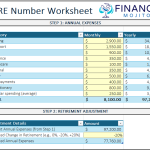
Free FIRE Number Worksheet (Copy and Use)
Download the template below and fill in the fields that are highlighted in yellow. It includes all four steps.
How to Track Your Progress Over Time
Once you have your FIRE number, update it periodically:
| Frequency | Action |
|---|---|
| Monthly | Update your net worth (investments + savings – debt). Track spending against budget. |
| Quarterly | Recalculate your FIRE number (expenses may change). Check your savings rate. |
| Annually | Adjust for inflation. Review withdrawal rate assumptions. Run a Monte Carlo simulation (free tools: FireCalc, Engaging Data). |
Free tracking tools:
| Tool | Best For |
|---|---|
| FireCalc | Historical market simulation (US focus) |
| Engaging Data FIRE Calculator | Visual, easy to use |
| CPF FIRE calculator (unofficial) | Singapore‑specific |
| EPF i‑Simulasi | Malaysia EPF projections |
My Take (Finance Mojito Style)
When I first calculated my FIRE number, it scared me. The number was big. Really big.
Then I broke it down. Not “I need 1 million.” Instead: “I need to save $2,000 per month for 20 years.” That felt doable. Then: “I need to increase my savings rate from 10% to 30%.” That felt challenging but possible.
Your FIRE number is not a judgement. It is a target. A target you can adjust as life changes.
Start with an honest expense number. Use the worksheet. Do not compare your number to anyone else’s. Their life is not your life.
And remember: the number is not the goal. The freedom that number buys – that is the goal.
Here is to your financial clarity. One sip at a time. 🍸
Your 30‑Day Action Plan
| Week | Action |
|---|---|
| Week 1 | Gather 3 months of bank statements. List every expense. |
| Week 2 | Calculate your current annual expenses. Be honest. |
| Week 3 | Apply the withdrawal rate (4%, 3.5%, or 3%). Calculate your FIRE number. |
| Week 4 | If you are in SG or MY, adjust for CPF/EPF. Copy the worksheet and save your number. |
Related Guides
- The FIRE Movement Explained (Lean, Fat, Barista FIRE) – The foundation
- How to Start Investing with $100 or Less – Building your portfolio
- Dollar‑Cost Averaging (DCA) Explained – Investing consistently
Before You Go
Your FIRE number is not set in stone. It will change as your life changes. But having a number – even a rough one – turns “someday” into a plan.
Calculate it. Write it down. Then take one small step toward it today.
Next up: The Psychology of Debt – Why We Overuse Credit Cards (And How to Stop)

Discover more from Finance Mojito
Subscribe to get the latest posts sent to your email.